

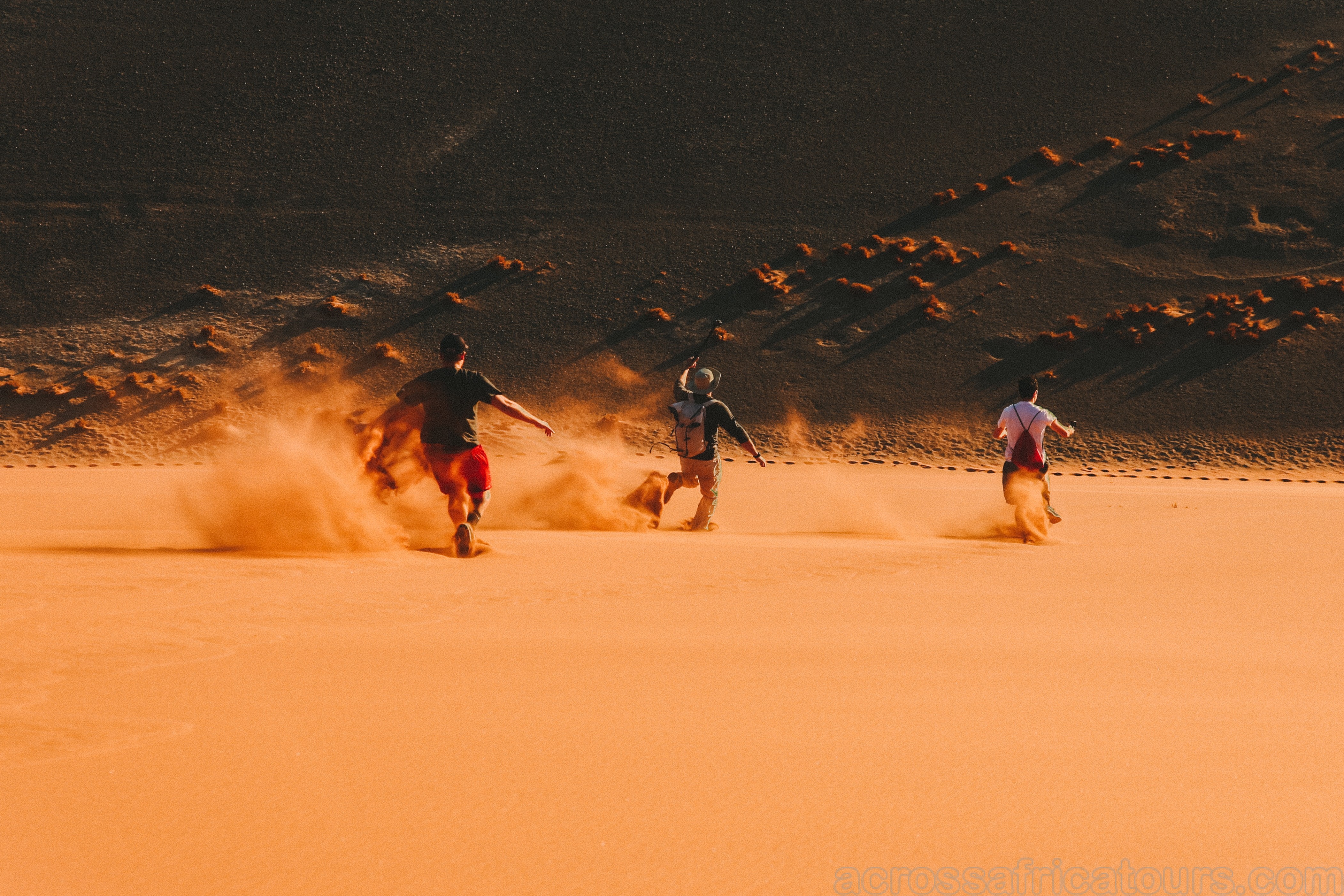
Are you a thrill-seeker or looking to spice your life up a bit? Then Namibia is the place for you. Whether you are interested in going paragliding over dunes or Hiking at the Fish River Canyon, then Namibia is the place you should visit.
Located on the southwestern coast of Africa, Namibia offers something for everyone, especially budget-minded travelers. Everything from accommodations to spa treatments to boat tours comes with the best price tag.
Few places in Africa beat this region for sheer photogenic beauty thanks to Namibia desert, Etosha National Park, – Swakopmund sea, Dusternbrook Game farm, Walvis Bay Lagoon, Luderitz Peninsula, and amazing Sossusvlei.
Here, you can go in search of the big five game and free-roaming cheetahs. Birdlife is prolific here too with other 600 different species of birds, including penguin, ostrich, and pelican.
There is also the Skeleton cast – a harsh but handsome shoreline littered with the radiant salt pan of Etosha. Here, the quirky – often chaotic atmosphere of the wilderness, runs elbows with uncorrupted natural beauty. Namibia can satisfy curious wanderers of all ages.
Namibia Brief History
It was the Portuguese who first set foot on Namibia’s shore, but it was the Germans who claimed the country as their colony in 1884. Namibia remained under German rule until 1915, and evidence of this history is clear to see the colorful colonial towns. And as you would hope, their beer is pretty divine!
Namibia Capital: Windhoek
Population: 2,494,530 people
Area: 825,615 km²
Major Religion: Christianity
Official Language: English
Quick note: Although English is the official language of Namibia, German continues to be used in a wide range of spheres of Namibian life.
Tribes: 12 tribes
Climate: Namibia has two main seasons; summer and winter. November to April is the summer season; May to October is the winter season. The best time to visit Namibia is in the Dry season from June to October, although it can be visited throughout the year.
Dialing code: +267
Namibia Currency
Currency: Namibian dollar and South African rand
Symbols: N$
Emergency Numbers: +264 (61) 10111. for police, +264 (61) 211 111 for Ambulance
CULTURE AND DESTINATION
Himba People of Northern Namibia
Himba people offer a delightful insight into Namibia’s melting pot of cultures – living in Northern Namibia, in the Kunene Region. These semi-nomadic people have layers upon layers of traditions.
Quick peep – As water is scarce in the Northern part of Namibia, Himba people use a mixture of pastes on both their hair and bodies. This paste gives the women’s hair and skin a distinctive red glow, which symbolizes the earth’s rich red color and the essence of life.
Himba people wear thongs, and elaborate braids, and also wear leather bands around their necks. The Himba have long allured travelers, drawn to their exotic ochre-colored skin, calfskin skirts, and hairstyle. For culture enthusiasts, this is a once-in-a-lifetime experience.

Namibia cuisine
With the sizable German immigrant population, it is hardly surprising that many of Namibia’s diverse restaurant serves different foods across the globe.
Notable Namibia cuisine also features elements of other cultural food; a few staples, the most common of which is oshifima – a doughlike paste make from millet, usually served with meat.
Namibia’s traditional dance and music
Namibia music is exceptionally diverse. Their cultural migrations and agricultural practices are all inscribed and revealed in music and dance. Their traditional dance and music are something you definitely wouldn’t want to miss!
Namibia desert
The desert is one of the World’s most stunning places for hot air balloons. You rise at dawn as the dazzling sun turns the vast Namibia landscape from blue-grey to golden like a chameleon, and rises over dunes. It is well worth the trip! Take time to explore the Namibia desert and experience its uncorrupted natural beauty.
Sossusvlei desert
Imagine mountains made of sand, and you are halfway to picturing the stunning dunes of the Sossusvlei desert. This mother nature’s masterpiece is a world of vast spaces, endless horizons, jagged mountain heights, and dramatic desert capes. It is an incredible place to relax, unwind, and reconnect with your inner child.

Etosha National Park
The park is amongst the African best, thanks to its numerous stunning waterholes that practically guarantee a sheer photogenic beauty.
The park incorporates the Etosha salt pan and holds an African bush elephant, white rhino, and other 600 different species of birds, including penguin, ostrich, and pelican.

Swakopmund Ocean
Swakopmund Ocean provides relief from the central heat with a sea breeze and coastal fog. The northern part of Swakopmund holds more than 100,000 Cape Fur Seals. The Ocean creates a peaceful atmosphere that will make you feel like you are stepping into a fairy tale.

Lüderitz
Explore the coastal town of Lüderitz in Namibia and visit the nearby ghost town of Kolmanskop, which is almost swallowed by Namibia Desert Dunes. Legend has it that the town’s fate was sealed when the wealthiest diamond fields ever known were found on the beach terraces to the south. Lüderitz is a must-visit if you consider yourself an adventurous traveler.
Walvis Bay
Year after year, millions of travelers visit Walvis Bay Lagoon to experience the awe of its natural wonder. The bird life on the lagoon, including pelicans, flamingoes, and many small waders will make you bow before the wonder of its uncorrupted beauty.

How to get a VISA to Namibia
- Fill out and sign the application form. Attach your passport – with at least six months validity from the date of entry and at least three or more blank pages. Also attach two-colored 2″x2″ photographs, taken within three months before the actual date of application, showing a clear front view of your face, with a white background.
Helpful Travelling tips
- Book through an agent directly to save costs. Since OTA’s takes commissions
- Currency and Banking. The currency of Namibia is the Namibian dollar (1N$). There are approximately 1N$ to 0.068 USD.
- Dress Modest